

The material life of ghosts
Author: Ioana Brunet
Growing up in the 1990’s in a small town in the northern part of Romania it was like growing up in a ghost town. It was a landscape marked by desolation and abandonment. A big deserted construction site of a four-story building sat in the middle of the town and challenged our survival skills, as we were a bunch of rebellious teenagers facing the dangers of our (then) whole world. I will always remember my sister being really close to falling off with her skateboard from the 4th floor of that building. That was the moment when we realized that our playground could be deadly. The place became, in the years to follow, one of the landmarks of the town, a branch of the Best Western Hotels, located in the center of Gura Humorului, an expensive accommodation central to the tourism-centered development of the region. My memories, before I left for college in 2004, are of empty streets, poverty, abandoned factories, a lot of farmers coming to the weekly market with homemade products, nature taking over old communist buildings, and Turkish products in the local market, as the people started going to Istanbul to buy cheaper gold, jewels or clothes.
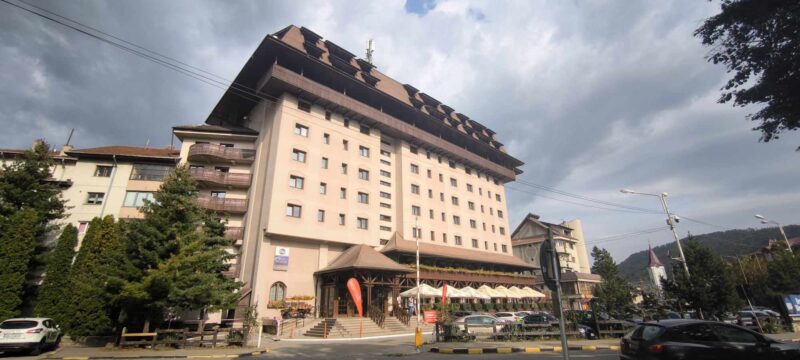
Best Western Hotel (Photo: I. Brunet)
Like most of Romania in the first decade after the 1989 Revolution, this town was also facing the post-socialist deindustrialization and the economic precarity that came with it. I left home for the capital, Bucharest, with the despair of a teenager who wanted to get rid of the stillness and decay that surrounded me.
Year after year, coming back home for Holidays or just a couple of days for the summer vacation I started observing the changes. At first some new bank offices, then some new restaurants, and some new tourist accommodation options. But the real boom started in 2007, when Romania became part of the European Union. Since then, there has been a flurry of construction and development, driven by European funding and a renewed focus on tourism. The town, being situated in the middle of Romanian Bukovina, surrounded by medieval monasteries, had an advantage in becoming a tourist center for the region, with a few of these monasteries becoming part of UNESCO World Heritage. The mayor, who has been in office since 2004, started accessing European funds, seeing tourism as the only option for the economic development of the town. In various media interviews the mayor declared that his purpose was to “reinvent the town” and “to get rid of the ghosts”.
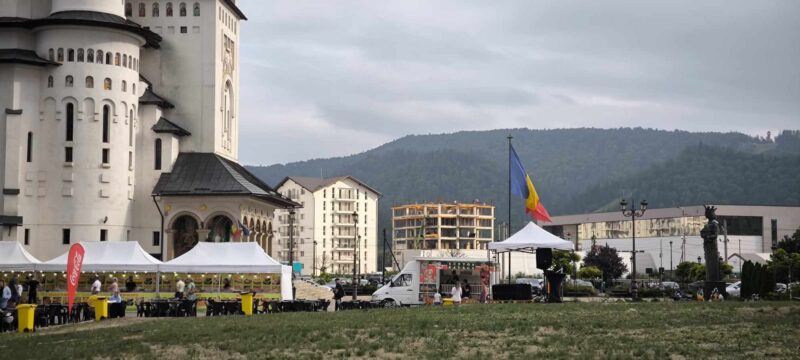
Construction frenzy (Photo: I. Brunet)
But what does this reinvention entail and what are the ghosts?
As the mayor’s vision took shape, the urban landscape changed. These ghosts appeared to be embedded in the buildings and monuments that populate the town. As mentioned before, the construction site in the middle of the town became a grand hotel. Half of the central park was cut down to make room for a big cathedral. The cinema next to it was demolished at the beginning of this year, as it was considered in danger of collapsing. In the former communist Cultural Hall of the town, known informally by the locals as the “Jewish House” (a gathering place set up by the former Jewish inhabitants, before the war), another EU funded project made way for the local Romanian Traditions Museum. New monuments, statues and memorials appeared. New events and marketing promotion materials celebrating the former cosmopolitan imperial multi-ethnic composition of the region started informing both the tourists and the locals about the history of the town and the region.
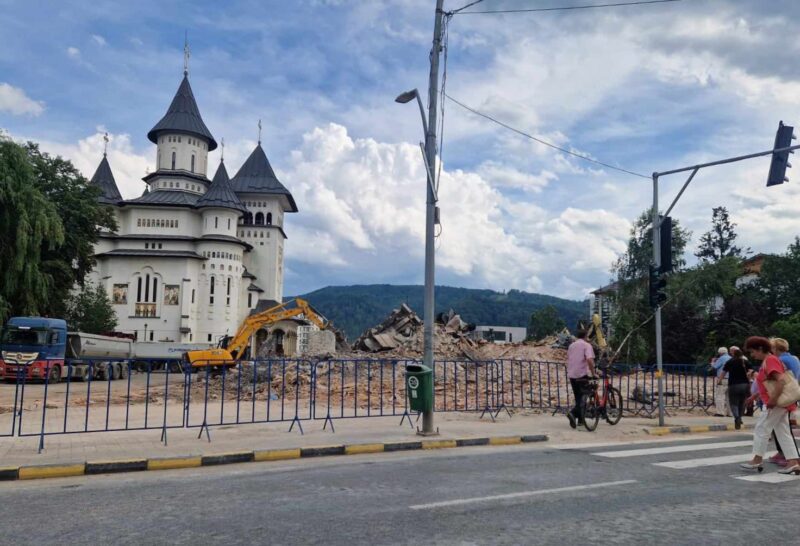
Demolition of the Cinema
In this context, there are two dominant narratives: the cosmopolitan, imperial past of Bukovina, and the national, traditional Romanian past. The former is symbolized by the town’s efforts to celebrate its multi-ethnic heritage, such as the annual Oktoberfest in the East Festival, or the dedication of a statue to the Ukrainian poet, born in this town, Olha Kobylianska. These acts of commemoration highlight the region’s historical ties to the Habsburg Empire and its diverse population.
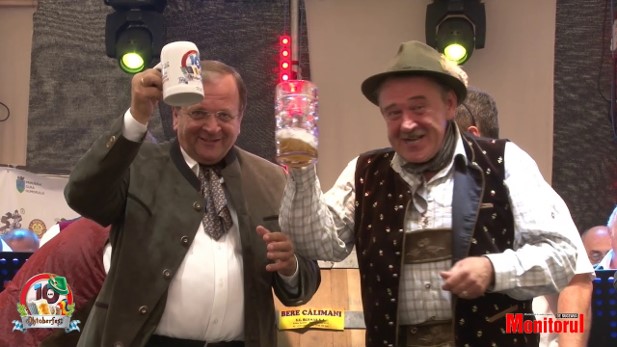
However, this celebration of cosmopolitanism is selective. The town’s Jewish heritage, which is inextricably linked to its German past, is largely silenced. The transformation of the former Cultural Hall into a Romanian tradition’s museum is a striking example of this selective memory. While the museum celebrates the town’s Romanian heritage and local “authentic” traditions, it glosses over the building’s history as a site where Jewish residents were held before being deported to Nazi camps during World War II.
The tension between competing narratives is further evident in the town’s treatment of its Soviet and German war memorials. The monument located in the center of the town, dedicated to Soviet soldiers has been restored, yet a nearby mortuary stone honoring German soldiers “who died fighting the Bolshevik enemy” is still maintained by locals, with candles frequently lit in remembrance. This dual commemoration reflects the complex interplay of memories in a region shaped by multiple layers of history and conflicting allegiances (see this field glimpse on our Facebook page).
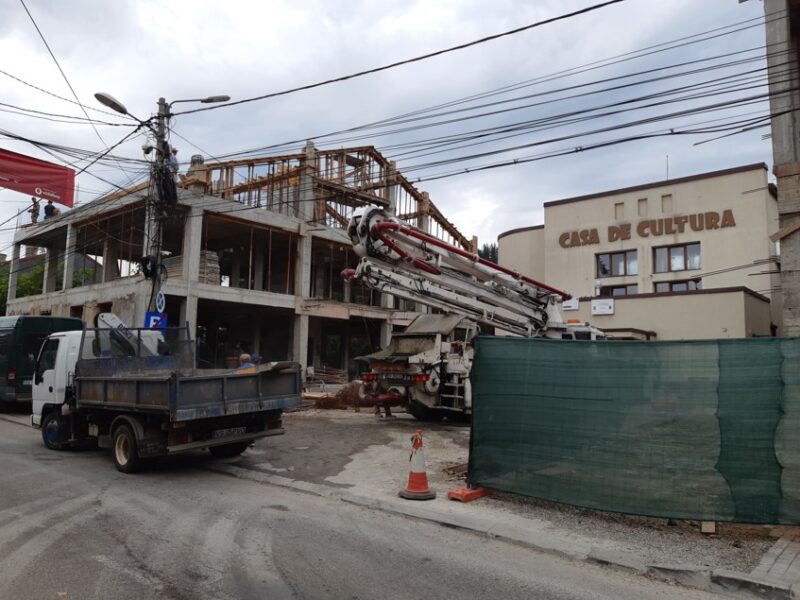
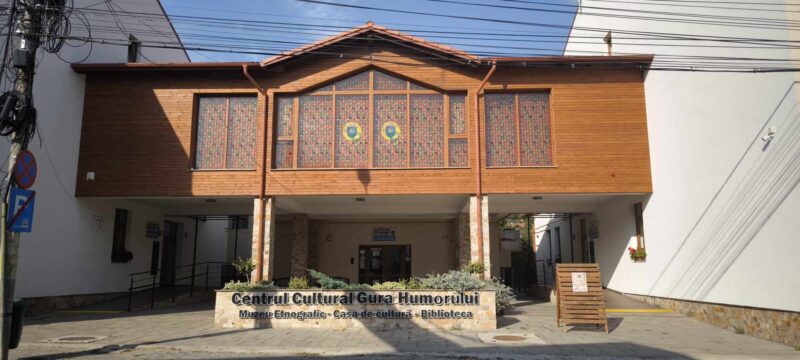
The Cultural Hall Project (Photo: I. Brunet)
The ongoing transformation of the town’s urban landscape raises important questions about the materiality of these “ghosts”, as remnants of the past that continue to haunt the present. The concept of “imperial duress”, as articulated by Ann Laura Stoler (see Stoler 2016), provides a framework for understanding how these ghosts manifest in the material culture of the town. The buildings, monuments, and memorials that populate the town are not just physical structures, but also embodiments of the unresolved tensions and contradictions of the past. “The prestige of association” (see Oltean 2018) with the German heritage, although it has less to do with the multi-ethnic past and more to do with legitimizing the region as relevant and valuable on the national and European stage, follows the same imperial logic of the civilizing agency of the West over the European periphery. The national(istic) perspective that we were taught in school, as being “guardians of Orthodoxy” in the face of the “pagans” (Muslims) may appear contradictory, but it works well along with the imperial past when understood as part of a broader Christian “European identity” (see De Cesari 2020)
The demolition of old buildings, the construction of new ones, and the creation of monuments and memorials are all acts of material culture that reflect broader processes of memory formation and identity construction. These acts are not neutral but are imbued with power, as certain narratives of the past are privileged while others are marginalized or erased.
Moreover, the “getting rid of the ghosts” may in fact have the contrary effect to what the mayor wishes, as, following Adrian Forty’s argument (see Forty 2001), the absence of certain structures or spaces can be just as powerful—if not more so—in shaping memory as their presence. This concept is particularly relevant in the context of urban transformation, where the demolition or abandonment of buildings can leave behind traces that continue to influence how communities remember and engage with their past.
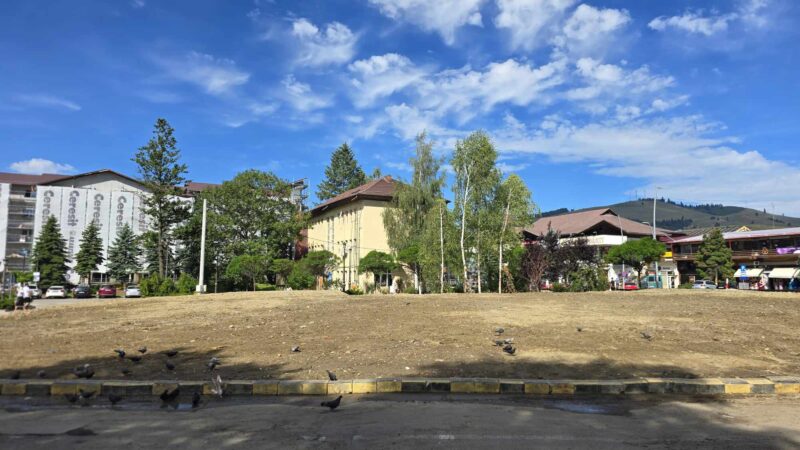
Empty space (Photo: I. Brunet)
The mayor’s vision of reinventing the town is, therefore, not just about economic development but also about controlling the narrative of the town’s cultural heritage. By selectively remembering certain aspects of history and forgetting others, the town’s leaders are attempting to create a new identity that aligns with contemporary political and economic goals.
Despite the top-down nature of many of these developments, there is also significant grassroots involvement in the town’s transformation. Some locals, including some who have returned from working in Western Europe, are actively engaged in shaping the town’s future. These returnees bring with them new ideas and practices, often inspired by their experiences abroad, and are eager to contribute to the town’s reinvention. For example, a small team of locals and returnees is attempting to reconstruct a map of an older version of the town, trying to identify the location of different old buildings. This type of interest, research-oriented, is met with skepticism and rejection by the local authorities, as I found out as well regarding my own research interests. Probably fearing criticism or obstacles in the future local development projects, the bureaucratic “blurring” of public information, which tries to make access to it as difficult as possible, means that the majority of residents do not have a real say in the urban development of the town.
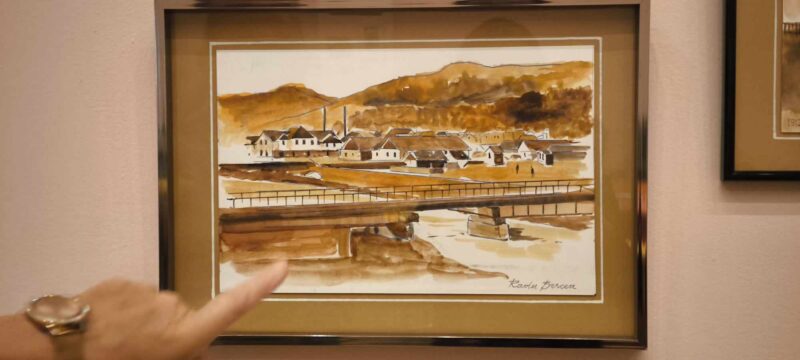
The old town artistic project (Photo: I. Brunet)
Moreover, this “reinvention” is not always smooth and it can even lead to open resistance. There are divergent visions for the town’s future, with some residents embracing the changes while others refusing them. The debates over which buildings should be preserved, which should be demolished, and how the town’s history should be represented are indicative of broader struggles over memory and identity.
In the end, the town’s urban landscape is a palimpsest, where different layers of history are written and re-written, remembered and forgotten. In this process, the ghosts of the past continue to haunt the present. We can try to erase them or honor them, but the buildings and spaces in which we move are never neutral.
*Photos taken by the author in the course of 2024, with the exception of “Demolition of the Cinema” and “German soldiers’ memorial plaque” taken by local friends, to whom I owe a big thank you!