

Stepping into Ambivalence – Populism from Below in Serbia
Author: Astrea Nikolovska
Once upon a time, in the mid-2010s, Belgrade’s central tourist zone mushroomed with various souvenirs featuring Vladimir Putin as their main character. T-shirts, hoodies, mugs, pins, and magnets were sold at every souvenir stand throughout the city center. Radio Free Europe published a short article naming this phenomenon a “Putin mania.” When something is proclaimed “mania,” it often suggests a kind of irrational collective obsession. The term, in this popular sense, draws from the 1960s, when a British journalist named the youth craze over the Beatles “Beatle Mania,” signifying the love for the band as a threat to the white-Christian moral order. The term does not always have a negative connotation. In 2005, for example, the British media coined “Murray Mania” to capture the public’s hopeful excitement over Scottish tennis player Andy Murray’s chances of winning Wimbledon.
Nevertheless, the term mania carries an inescapable pathologizing undertone. Its roots lie in psychiatry, where mania designates a state of psychological disorder like excessive energy, loss of control, and irrational behavior. When used to describe popular affect, it thus frames public enthusiasm outside the regular, acceptable boundaries of behavior, making it too emotional, unreasonable, and often outside the accepted, hegemonic, political, or moral order; in one word, delusional.
But can the proliferation of memorabilia featuring Putin’s face truly be dismissed as irrational or delusional? Calling it mania makes it seem like a passing craze or emotional overreaction, which is always an aspect of a mania. Still, this label overlooks the deeper context in which manias emerge. It further pathologizes a behavior that is not a symptom of psychological disorder, rather a popular expression that challenges the dominant hegemonic order, which tries to fix identities into clear categories, being moral, as good and evil, rational and irrational, or, as this case most prominently talks about, geopolitical, like “East” and “West.”
In contrast to “Western” contexts, where affiliations with NATO, the EU, or the UN impose tighter boundaries around political belonging, Serbia inhabits a more fluid, contradictory position. It resists simple categorization due to its decades-long historical association with Yugoslavia. Until the nominal end of the Cold War, Serbia was part of a socialist, non-aligned federation that positioned itself outside both NATO and the Soviet bloc, nurturing the legacy of sovereignty, self-reliance, and skepticism toward global power structures. During the 1990s, the violent disintegration of Yugoslavia, followed by the UN embargo and international isolation, further complicated this legacy. The NATO bombing in 1999, executed without UN Security Council approval, deepened public resentment toward “Western” institutions and reinforced a sense of betrayal by the global order. At the same time, Serbia remained formally tied to many of these same institutions, borrowing from the World Bank and IMF, belonging to the UN, maintaining the accession dialogue with the EU, and even participating in NATO military exercises. Serbia also actively nurtures political, economic, and cultural ties with Russia and China, deepening its entanglement in competing global projects and imaginaries. These overlapping allegiances do not cancel each other out; instead, they coexist simultaneously, producing a geopolitical orientation that is neither fixed nor static, but ambiguous, ambivalent, and situational.
This uneasy coexistence of resentment and dependence, skepticism and engagement, shapes to a large extent how political symbols like Vladimir Putin souvenirs emerge as popular objects, and how they are received, not as some sort of blindly admired totems, but as ambivalent figures through which people express irony, nostalgia, resistance, or general frustration with the world that rapidly gets complicated. In the early 2010s, worshiping Putin had not yet become a geopolitical taboo. From the “Western” perspective, he has always been seen as an authoritarian leader, but not yet the pariah figure he would later become. At that time, Putin was still regularly meeting with “Western” leaders, shaking hands with Barack Obama, negotiating with Angela Merkel, attending summits, and playing the role of a difficult but necessary interlocutor. Europe, in particular, remained highly dependent on Russian energy, and this economic entanglement required a certain degree of political tolerance. Even though the annexation of Crimea in 2014 and the war in Eastern Ukraine framed Putin as “the bad guy,” he was the kind of bad guy that the West could still do business with.
A decade later, the geopolitical landscape has undergone dramatic changes. Russia invaded Ukraine in 2022, which solidified Putin’s position in the “Western” imagination as the number one villain on the international stage. The once-tolerable business partner became a symbol of global threat, economic instability, and moral decay. As the war escalated, energy supplies were cut, and prices across Europe skyrocketed, leading to a surge in inflation. In the public discourse, Putin came to embody everything Europe found itself trapped in: dependency, vulnerability, and the failure of liberal internationalism to foresee or prevent war. He was no longer just an autocrat at a distance; he became the personification of European anxieties and the face of the failure of the post-Cold War liberal order.
Despite all that, Putin’s face continued to fill souvenir shelves across Belgrade as if nothing had changed. While much of the world descended into political crisis, economic panic, and moral reckoning, in Belgrade, it was business as usual: Putin on mugs, Putin on T-shirts, and now, additionally, Putin on socks, the latest novelty to the city’s souvenir offer. And he was no longer alone. Putin on socks came accompanied by the company of Donald Trump, Kim Jong-un, Muammar Gaddafi, Viktor Orbán, and other strongmen of similar provenance.
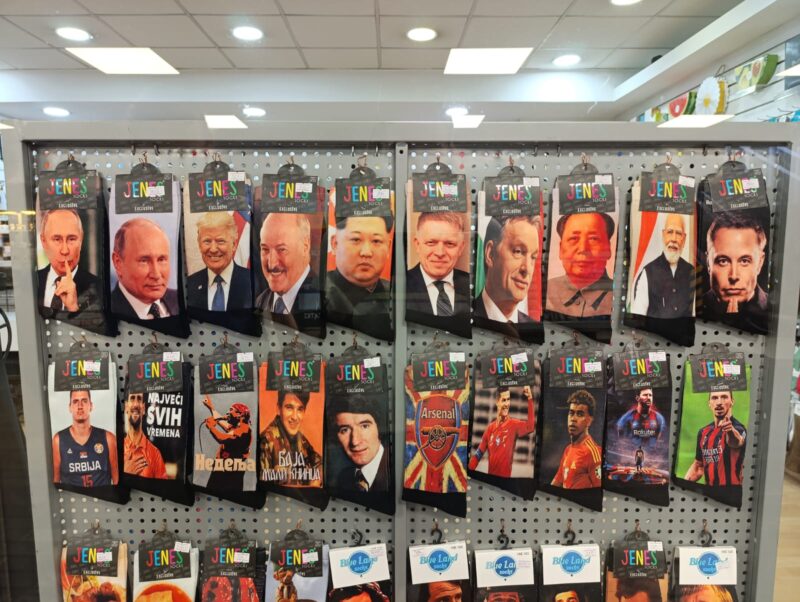
Gift shop window in Belgrade, May 20205, photo by Astrea Nikolovska
Even though these socks are sold in a country that has been historically and currently entangled with many of these faces, having itself a leader worthy of being included in this gallery himself, they are not part of any sort of state propaganda or institutionalized narrative. They are a pop-cultural, vernacular object that emerged from below. Stumbling upon a stall where the faces of Kim Jong Un and Trump sit alongside those of Harry Potter, Lionel Messi, and Van Gogh’s autoportrait, the first impression is one of absurdity. What in the world is happening here? How did all these faces come together on a souvenir stall in Belgrade on no less than a sock? But as philosophy and theatre have taught us, absurdity emerges not from nonsense, but from the collapse of sense itself, in that very moment when categories blur and meaning no longer holds.
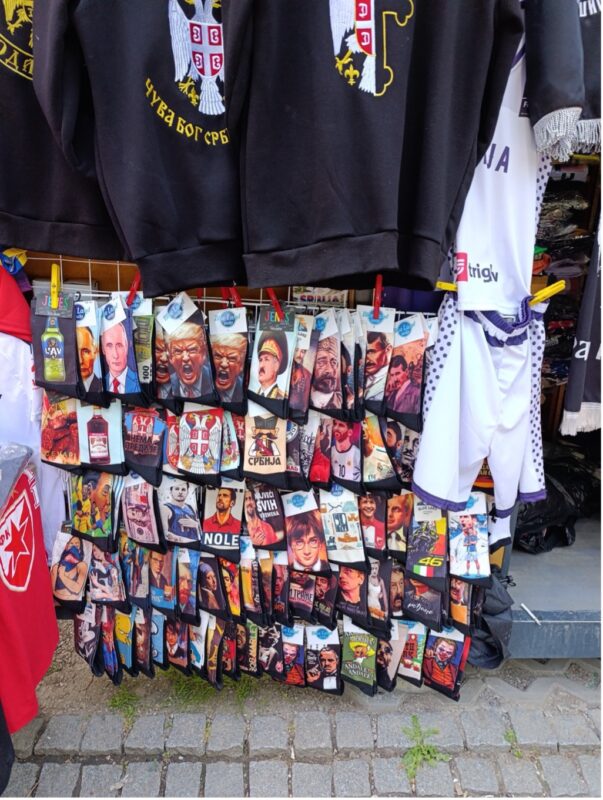
Souvenire stall at the Belgrade fortress Kalemegdan, May 2025, photo by Astrea Nikolovska
The absurdity here reveals a collapse of the symbolic order, a contemporary political and social moment in which distinctions between fiction and politics, villain and hero, history and fantasy, and most importantly, “East and West,” no longer hold. In Serbia, a country that has been navigating complex alignments, these socks can be seen as tokens of political ambivalence; they neither celebrate the politicians depicted on them nor quite ridicule them. They become a site where the contemporary contradictions are quite literally woven together. Stepping into them, one also steps into a world where politics is increasingly driven by affect and spectacle, rather than ideology or coherence. The socks allow us to step further into the social and political ambivalence that Serbia has represented for decades. However, what is most telling is that both foreigners and Serbs readily purchase them without hesitation. When I asked the souvenir vendor who buys these socks, he replied lightly: “Our people, and tourists equally.” This shared consumer interest suggests that the contradictions and political taboos these objects embody extend far beyond Serbia.
The political ambivalence is global. The sense of ideological disorientation, the collapse of clear moral or geopolitical categories, is something many people feel. However, in most places, it remains unspoken, not because it does not exist, but because the vocabulary that could express it is not available. The categories invented during the Cold War, such as “East” and “West,” as well as liberal and authoritarian, good and evil, security and threat, no longer capture the complexity of the moment. The boundaries that once organized the world as Cold War binaries, moral hierarchies, and communist versus democratic geopolitical allegiances are rapidly blurring. The “West’s” presumed moral superiority is increasingly challenged, not only by the powers like China or Russia or the rise of South-Asian, African, and Latin American economies, but from within, as demands to reckon with colonial violence, historical erasures, and structural inequalities intensify. The very institutions that claim to uphold universal values, such as the UN, NATO, ICJ, ICC, and the EU, are viewed in many places as partial, self-interested, or inconsistent. Liberalism no longer feels like a neutral, impassive pillar, but like one political option among many, often failing to account for people’s lived experiences of inequality, disillusionment, or humiliation.
At the same time, the global moral compass was thrown into disarray. After Hamas’s attack on October 7, 2023, Israel launched a large-scale military attack on Gaza. As the death toll among Palestinian civilians rose and humanitarian organizations raised alarm over war crimes and genocide, many “Western” governments remained silent or offered unwavering support to Israel. Many observers noted the double standards of “Western” powers. The double standard casts doubt not only on the “West’s” credibility but on the very idea of universal human rights, suggesting that some lives are more grievable than others, and some civilian casualties more politically useful. The vocabulary of international law, human rights, and humanitarian intervention, once mobilized to justify the post-1989 liberal order, now seemed hollow, selectively applied, or brutally ignored. The invasion of Ukraine and then the attack on Gaza reactivated language, fears, and geopolitical imaginaries of the Cold War. Still, this time, the clarity of the ideological divide had eroded. In 2024, the global stage seemed more confusing than ever, caught between nostalgia for a past structure and the inability to name or navigate the present one.
Serbia, however, and Belgrade in particular, offers a space where that confusion is not only visible, but lived and openly consumed. The state itself occupies an in-between position, not fully aligned with any of the powers, and this liminal stance seems to enable a kind of open market for ambiguity. In Belgrade, the things that cannot be articulated elsewhere, such as the political contradictions, the uncomfortable affinities, and the guilty fascinations, are not silenced and repressed, but sold at eye level for a few euros on socks. To wear Victor Orbán, Saddam Hussein, or Kim Jong-un on one’s feet is not necessarily to endorse them. It is to participate in a new kind of meaning-making, one that is bodily, ironic, and resistant to simple interpretation. These objects blur the line between joke and statement, between mockery and nostalgia. They reflect a world where people no longer trust the categories handed down from above, where “East” and “West,” “good” and “bad,” “rational” and “irrational,” no longer hold explanatory power.
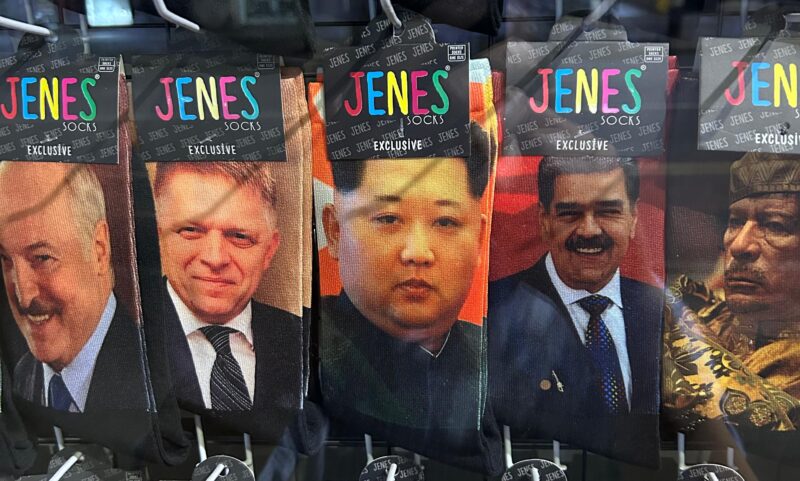
Gift shop in Belgrade, June 2025, photo by Nikola Mijović
And for that that cannot be named, the socks speak instead. They articulate confusion not through clear-cut discourse, but through juxtaposition. On one stall, Trump, Orbán, Kim Jong-un, and Messi coexist without hierarchy, commentary, or context. The socks do not explain; they stage. They do not declare a position; they only make visible the contradictions that liberal democracies often try to suppress or smooth over, staying ambivalent between glorification and irony. They do not tell people what to think, but rather reflect what people already feel, joke about, or cannot yet fully articulate. Worn on the body and sold in street markets, these socks articulate what liberal democracies often suppress: the collapse of stable categories based on hierarchies produced within the liberal order. They testify to the change of the rules of the game once invented and refereed by the winners of the WWII. They, however, do not proclaim new political loyalties, but instead give form to a spectacularized disorientation in which current politics is driven less by ideology than by affect, aesthetics, and irony. Like memes or graffiti, they operate through juxtaposition and absurdity, recalling the logic of what Laclau might call the empty signifier, a symbol whose power lies in its ambiguity, able to unify diverse and even contradictory demands by standing in for a broader sense of discontent, without anchoring itself to a single fixed meaning.
The socks became objects that stand for the space/time in which populism thrives. They represent a form of populism from below, a grassroots aesthetic practice that captures the contradictions, disillusionments, and ambivalences of the current geopolitical moment. In their absurd pairing of figures like Putin, Trump, Kim Jong-un, Messi, Van Gogh, and Harry Potter, they stage a kind of chaotic equivalence, flattening political, historical, and moral distinctions. This flattening is not a celebration of authoritarianism, nor an explicit critique; it is something messier: a condensation of global affective disorder into a consumable object.
Anti-hegemonic yet non-revolutionary, the socks reflect the logic of populism from below: they do not offer a clear alternative, but symbolically challenge the coherence of the existing order. They suspend judgment and instead reflect a world in which critique itself has become tangled in confusion. As such, these socks do not declare a position; they perform the incoherence of the global order. And in doing so, they allow publics, both local and transnational, to laugh, recoil, recognize, and step into the confusion together.
Like populism, these socks do not provide ideological clarity. They capture the mood of collapse, the sense that something is ending, but nothing coherent is taking its place. Populism speaks not in programs, but in symbols; not in policies, but in feelings. The strongman souvenir sock becomes a condensation point for all of this: a small, ridiculous object that holds together unresolved feelings of irony, resentment, nostalgia, and defiance. It does not ask for coherence; it allows contradictions. In this way, the sock becomes a quiet yet potent site of populism from below: not monumental, but wearable; not official, but affective; not loud, but intimate. They are vernacular expressions of political feeling, emerging not from institutions but from market stalls and bodies in motion. The socks embody both nostalgia and critique, not because they declare either position, but because they make space for both. They reflect the ambivalence of political feeling in a time when ideological clarity has broken down, and where populism circulates not as a coherent discourse, but as a structure of affect, irony, and uneasy memory.
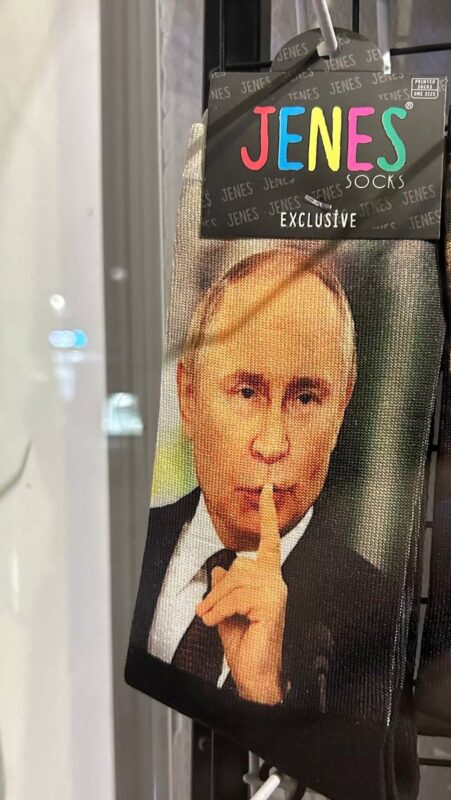
Gift shop in Belgrade, June 2025, photo by Nikola Mijović