

Re-thinking anthropological rapport at a place called „home“
Author: Franz Graf
If, instead of asking clever questions, one would rather leave it to Captain van Toch to grumble and curse to his heart’s content, one might learn more. Can’t you see that he needs to let off some steam? Just let him be; his bitterness will find its own vent. Karel Čapeki [translated by ChatGPT]
I had already called Lorenz a week ago to ask if he could imagine lending me his minibus for a few days during the field trip with the students so that we could make a few excursions together. I knew it wouldn’t be easy. The car, a fundamental tool of progress not just in this region, is inseparably linked to a patriarchal workforce through daily commuting to nearby cities: “You don’t lend out a woman or a car!” But, for his nephew and a good cause, he will probably make an exception.
Now I sit here, in the spacious wooden living room, on the huge red leather couch set, with the overpowering television droning on with a monotonous German courtroom show, while Aunt Adele serves us two double espressos in large white square ceramic cups. I talk about the plans to drive to Southern Burgenland, to the Open House Oberwart – we want to see a stage performance about two Burgenland Croats in the resistance, based on the biographies of Hanna Sturm and Käthe Sasso, who survived the concentration camp. This would fit well with our visit to the “Garden of Remembrance” at the former synagogue and the tour of the Jewish Frauenkirchen with local historian Herbert Brettl.
At the beginning of our “negotiations,” it’s still about formalities: “Isn’t that too far, and much too dangerous at night?” Then, the different perceptions become apparent: “Why do you even need to go there [to the OHO]?” The Open House Oberwart describes itself as a space to address the issues that a borderland like Burgenland, which has evolved over centuries, raisesii and represents, for me, one of the few intellectual and progressive centers in Burgenland. For him, it represents a “leftist filthy gang,” a “drug den,” primarily remembered for police raids. His time with the police is long over, and he admittedly doesn’t rule out the possibility that there might have been a positive development at the OHO.
But – and then we are right in the middle of those debates that I had long avoided and that had been one reason for my distancing from this borderland and move to Vienna – he doesn’t understand what this whole culture of remembrance is about: “At some point, you have to let the past rest. What can we do today about what happened in the past? We didn’t cause it. It was the time of our fathers and grandfathers, and of the Nazis, but what does that have to do with us today?”
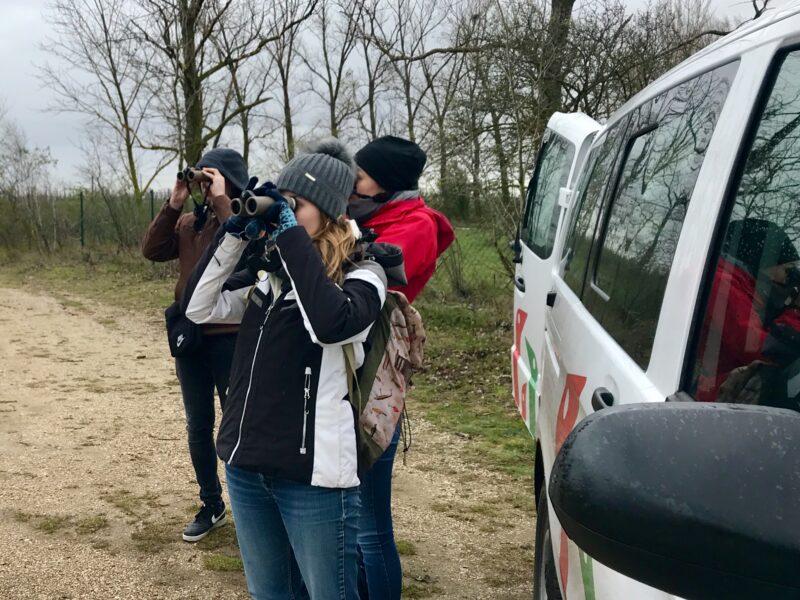
Looking for rare birds in the Neusiedler See-Seewinkel National Park on the eastern edge of the Alps and the western edge of the Pannonian Plain, which attract ornithologists and others from all over the world, including some anthropologists. (photo: F. Graf)
The panel by Julia Koch Tshirangwana and Judit Tavakoli at this year’s EASA conference “Doing and Undoing with Anthropology,” titled “Goodbye ‘Lonely Hero’ – Hello ‘Relational Self’: The Practice of Accompanied Research,” prompted me to reflect on the role that family ties of researchers in the field play. The contribution should be something current, so I did not refer to my accompanied dissertation research in Southwest England in 2012-2013, although it would have been quite fitting: my son was born there during our field stay and significantly influenced my research on “the only religion England has given the world,“iii contemporary Paganism.
If it weren’t for him and the caregiving responsibilities shared by his mother and me, I might not have taken the Pagans, who were far ahead in their understanding of climate science compared to my then (Austrian) perspective, as seriously. They knew and understood the IPCC reports better than Austrian journalists. As a new father, I was both moved and disturbed by the dystopian (and utopian) visions associated with global warming. The fringe phenomenon of Neo-Paganism suddenly became something I could explore more closely and empathetically regarding the practical human-environment relationships involved, something that wouldn’t have been possible without my new role as a father.
My most recent experiences with accompanied research were also not the focus of the workshop. Through the field schools I have conducted in recent semesters with my friend, anthropologist Gertraud Seiser, in Burgenland as part of the MA in Social and Cultural Anthropology at the University of Vienna, the blurring of boundaries between professional and private life in anthropological research has come to the forefront. The direct involvement in everyday matters that such close supervision entails raised a variety of questions regarding collaborative research. The collaborative effort to establish rapport and the concern for the students’ research well-being was also accompanied by a fear that one’s own field site might be compromised through the students’ engagements. Instead, through the concept of “forced collaboration” that the convenors at EASA put upon us – two panelists were paired together and had to present jointly – thanks to Vani Xaxa, an independent researcher living in New Delhi, I was thrust directly into the present and into my current challenges in preparing my research in Burgenland as part of the “Memory and Populism from Below” project.
Through discussing the diversity in our research context we benefited from what Michael Shanks terms catachresis, a “forcible juxtaposition designed to produce frictions.”iv This heuristic tool made me aware, that in my fieldwork in the rural Austrian-Hungarian borderland, fears are specifically shared: I share concerns about Europe’s (or the global?) illiberal turn, the resurgence of hatred and scapegoating, and the rewriting of the memory of 20th-century atrocities with my urban colleagues, liberal students, and academic peers, but less so with my rural interlocutors (some of whom are family), who are considered the culprits for the populist wave. Solidarity becomes a complex issue.
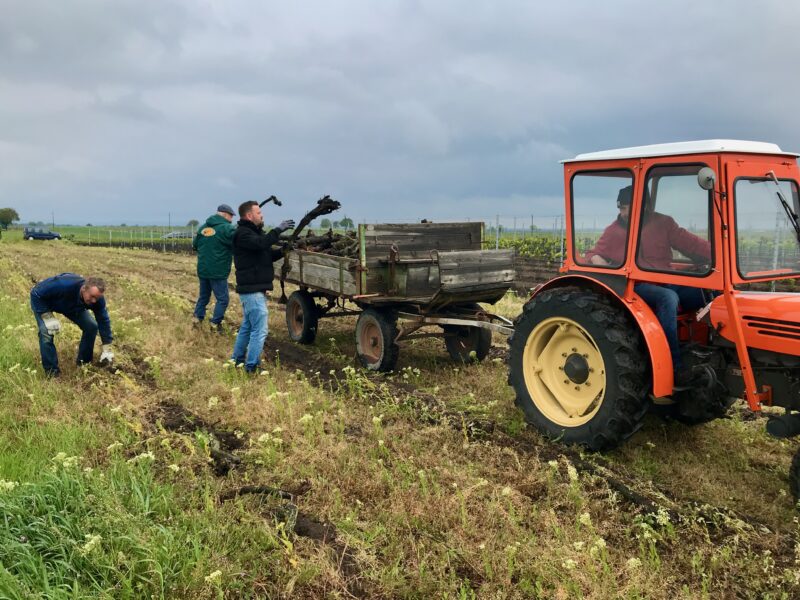
Brother, sons, nephews and friends collect the cut vines as part of clearing an old small-scale vineyard as a commemorative practice for the deceased relative before the burial ceremonies. (photo: F. Graf)
In my case, these frictions are also intrinsic and related to my “return” to Burgenland, the western part of the “Pannonian Province,” a region where self-confidence has been difficult to develop. Klaus-Jürgen Bauer attributes this to the fact that almost all parts of the Pannonian provinces are primarily agrarian, consist of border regions, and are dependent on subsidies. Where self-confidence might have developed, it was based on marketing a tourist lifestyle of sleepy rural tranquility.v This is especially true for the northern part of Burgenland. My mother grew up in a subsistence-oriented small farming household and was proud of having been a good salesperson throughout her working life. My father was the son of a reed factory worker and a day laborer.
Like many others after the agricultural crisis around 1900 and especially after the agricultural structural changes of the 1950s, he commuted daily to Vienna, the growing metropolis with its ample employment opportunities through construction projects.vi Initially, he worked as a brick layer, later becoming a construction manager. My parents managed to take over a mid-sized civil engineering company near Vienna and all three children became the first generation to go beyond compulsory education and completed at least one degree. I attended primary school and the lower grades of a federal high school in Burgenland, and then only spent weekends there until I found a home in Vienna and the university milieu. My Burgenland origins I mostly kept hidden during this time.
One could argue that I was intimidated by the narrative of the liberal elite, which I was trying to become a part of. To use Michael Sandel’s words, this elite is subject to a “meritocratic hubris,“vii sharing an arrogance and sense of superiority that arise from the belief that one’s success is solely due to personal talent and effort, neglecting the roles of luck, social background, and support systems. Sandel points out that access to elite educational institutions, often seen as the gateway to success, is heavily influenced by family wealth and connections, thereby perpetuating privilege rather than genuinely rewarding merit. This leads to a lack of social solidarity and increasing resentment among those left behind, contributing to political polarization and a populist backlash against the elites who are perceived as disconnected from the struggles of ordinary people. Moreover, it seems that even in a field like anthropology, the enthusiasm for “ordinary people” is waning.
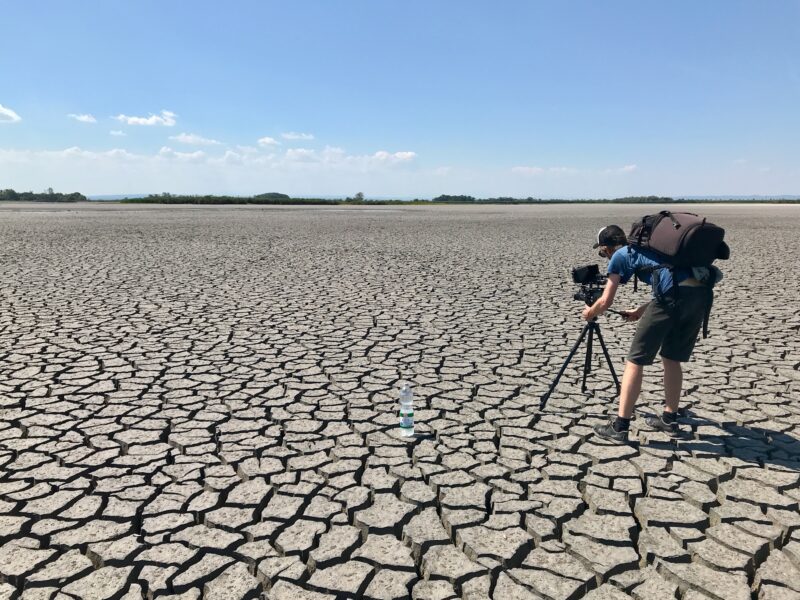
Filming by documentary filmmaker Christoph Schwarz at the dried-up Lake Zicksee in Burgenland, a region heavily affected by climate change, for an agitational video for a large Fridays for Future demonstration in Vienna. (photo: F. Graf)
Now I am “back” – reliant on reciprocal relationships, where material and immaterial aspects, a car and attentions, are both connecting and separating parts of social relationships. As a starting point for a relational approach to fieldwork in these contexts, I find Tim Ingold’s perspective helpful: anthropology is not a study “of” people but “with” people; a practice described as “observation grounded in participatory dialogue” and “an inquisitive mode of inhabiting the world, of being with, characterized by the ‘sideways glance’ of the comparative attitude.“viii Furthermore, fieldwork can be understood as a radical act of correspondence, where we commit to understanding a social reality beyond ourselvesix, while acknowledging that all research involves a process of self-discovery.x The question, “Who are the people we conduct research with?” involves the question “Who is asking?” And: What responsibilities and solidarities emerge from this (changing) interaction? How do differences and boundaries become visible? And what role do affects play in this process?
To formulate a plan for anthropological research in a region deeply intertwined with one’s personal history requires standard research preparations—exploratory visits, studying relevant literature, and methodological planning for gaining access. Additionally, it involves reflecting on personal interconnectedness, despite fears that this might overshadow the task of understanding social phenomena or reveal the researcher as a real person rather than a detached observer. Reflecting on the researcher’s positionality (class, age, gender, ethnicity, and family status) is essential for good research practice. Furthermore, reflection becomes an inherently relational matter and not merely a one-sided issue of individual contemplation of one’s self-perception. It is intertwined with the question of how we are perceived by others and how these perceptions influence our research. How I am perceived in the field can differ significantly from my own perception of myself. Perceptions always exist in a relationship,xi and tensions and conflict lines might provide insights into the social worlds we explore.
Standard disciplinary approaches, including anthropological ones, have their procedures, but strictly following social science methodological protocols does not necessarily lead to useful and progressive results. In particular, if we want to contribute to the debate on populism, we need creative approaches. We find ourselves in a moment of “intensified affect,” where an anthropology of populism, according to William Mazzarella, needs to note where “social life makes itself felt as an intensification that exceeds […] prevailing institutional mediations.”xii Accordingly, when the collective and emotional aspects of social life become so powerful that they surpass the control and influence of established institutions, we need a new understanding and vocabulary in anthropology to deal with it. By addressing these moments of intensified social and emotional energy, we may see where traditional institutions within anthropology fail to address or contain the collective sentiments and demands of the people.
Acknowledging that the reflection of the researcher’s (affective) positionalities is deeply tied to one’s values, beliefs, experiences, and expectations, and often involves “intimate speech,” we face a challenge that extends beyond classical anthropological writing and has hitherto been addressed more professionally in the genre of literary writing.xiii Karel Čapek, for example, was well aware of the difficulty of communicative practice when it comes to hardships and polarized views. However, in the anthropology of populism, anthropologists can no longer sit back and allow themselves to merely listen, as Čapek suggests in relation to Captain Toch. We are too affected by the “bitterness”—which we often attribute solely to the populists—because we realize that anthropology can no longer cling to a rigid notion of liberalism.xiv
![Inspection of the decay damages of the Tahara house at the Jewish Cemetery in Frauenkirchen, once one of the largest Jewish communities in Burgenland. Previously a space for ritual corpse washing, it is now used as a storage for the lawnmower. (photo: F. Graf)]](https://www.mempop.org/wp-content/uploads/2024/07/Bild-4_Tahara-800x600.jpeg)
Inspection of the decay damages of the Tahara house at the Jewish Cemetery in Frauenkirchen, once one of the largest Jewish communities in Burgenland. Previously a space for ritual corpse washing, it is now used as a storage for the lawnmower. (photo: F. Graf)
Returning to the vignette at the beginning of this text, of course, I should have borrowed a car from a professional rental company; the university would have covered the costs for the course, and I wouldn’t have had to expose myself and my inquisitive endeavor to the local discourse in such a close setting. Alternatively, I could have recorded my uncle’s statements and, in the spirit of a classic, objective and reliable data collection, analyzed them at my desk to expose the old white man as a die-hard reactionary to my academic colleagues. On the other hand, I could have tried to defend him, showing that his underlying motives are shaped by a sense of powerlessness in the face of rapid socio-economic changes during his lifetime and that his feeling of being left behind compared to the powerful in the country’s metropolises is harvested by populist political actors. However, all three options felt wrong to me. The depth to which the field “gets under our skin” and affects us deeply depends on how much we can engage with and distance ourselves from our construction of the field. This construction is tied to our notions of solidarity, reciprocity, and understanding, and it becomes even more complicated when we care for those we research with and cannot absolve them from responsibility.
For me, this raises the question of “radical solidarity.” In their 2018 essay “Introduction: The Rise of Trumpism,” Lucas Bessire and David Bond discuss this concept in the context of politically oriented anthropological research into contemporary challenges.xv By “radical solidarity,” they mean a form of unity that goes beyond superficial alliances and addresses the deep-seated inequalities and injustices within society. Radical, because it recognizes and respects differences while striving for a common goal of justice and equity. It aims to create shared worlds by finding commonality in the struggle against inequity. Bessire and Bond argue that this kind of solidarity is crucial in confronting the polarizing effects of populism and emphasize the need for an ethnographic approach that pays close attention to the everyday lives and struggles of ordinary people, transcending academic and social hierarchies.
This approach may be less suitable for fast academic careers. The simple request to borrow a vehicle (and the associated direction of his and our journey) developed into a two-hour conversation: an exchange on equal footing about the importance of a culture of remembrance, the question of Nazi guilt in Austria, and the responsibility we bear due to our history. I dare say that we both benefited from it; another conversation is certainly in the works. This form of radical solidarity, that acknowledges differences while still striving for a shared world does not require concealing one’s own positions. Although this may sound somewhat utopian, it resonates with Paul Freire’s vision of dialogue as rooted in humility, rejecting the notion that some people inherently possess knowledge while others are ignorant.xvi However, the recent political challenges are probably too serious not to be utopian.
i Čapek, Karel. Der Krieg mit den Molchen. Translated by Otto Pick. Munich: Deutscher Taschenbuch Verlag, 2000 [1936]. 10.
ii OHO website: https://www.oho.at. Retrieved, 20 July 2024.
iii Hutton, Ronald. The Triumph of the Moon. Oxford: Oxford University Press, 1999. vii.
iv Shanks, Michael. “Three Rooms: Archaeology and Performance.” Journal of Social Archaeology 4, no. 2 (2004): 147-80. https://doi.org/10.1177/1469605304041073. 152.
v Bauer, Klaus-Jürgen. Pannonien. Archipel: Theorie Der Provinz. Oberwart: edition lex liszt 12, 2007. 10.
vi Prickler, Leonhard. “Ebene Im Osten: Der Seewinkel Im Bezirk Neusiedl Am See.” In Geschichte der österreichischen Land-und Forstwirtschaft im 20. Jahrhundert: Regionen, Betriebe, Menschen, edited by Ernst Bruckmüller, Ernst Hanisch and Roman Sandgruber, 741-94. Wien: Ueberreuter, 2003. 746.
vii Sandel, Michael J. Wie die Leistungsgesellschaft unsere Demokratien zerreißt: Vom Ende des Gemeinwohls. Frankfurt/Main: Fischer, 2023.
viii Ingold, Tim. “Anthropology Is Not Ethnography.” Proceedings of the British Academy 154 (2008): 69-92. 87.
ix Davies, Charlotte Aull. Reflexive Ethnography: A Guide to Researching Selves and Others. London: Routledge, 2008. 217.
x Murphy, Robert F. The Body Silent: The Different World of the Disabled. New York: W. W. Norton, 1987. 126.
xi Ingold, Tim. The Perception of the Environment. Essays in Livelihood, Dwelling and Skill. London: Routledge, 2000.
xii Mazzarella, William. “The Anthropology of Populism: Beyond the Liberal Settlement.” Annual Review of Anthropology 48, no. 1 (2019): 45-60. 50.
xiii I have to thank John Palattella and the Wiener Kreis for making me aware of this. Additionally, the writings of Eribon (2018), Ernaux (2022), Louis (2024); and also Grois (2024) and Stoller (2023) might be helpful in elaborating the threshold between the professional and the private in a non-neo-liberal way.
xiv Mazzarella, William. “The Anthropology of Populism: Beyond the Liberal Settlement.” Annual Review of Anthropology 48, no. 1 (2019): 45-60. 50.
xv Bessire, Lucas, and David Bond. “Introduction: The Rise of Trumpism.” Hot Spots, Fieldsights, January 18. https://culanth.org/fieldsights/introduction-the-rise-of-trumpism.
xvi Freire, Paulo. Pedagogy of the Opressed. London: Penguin Books, 2017 [1970].