

Mnemonic Inclusion and Belonging in Populism
Author: Johana Wyss
Every November, the streets of Prague fill with candlelight vigils, public speeches, and concerts marking the anniversary of the 1989 Velvet Revolution. It is a celebration of truth, nonviolence, and freedom. And yet, as public memory of 1989 grows brighter, the political reality in the Czech Republic, and much of Europe, is moving in a less liberal democratic direction. Illiberalism is on the rise, populist parties dominate polls, and trust in liberal democratic system as well as its institutions continues to erode. In this blog post, I introduce the concept of mnemonic inclusion, a term I’ve developed to rethink how memory, populism, and liberal commemoration intersect in post-1989 Europe and beyond.
Mnemonic inclusion in populism is a way to think beyond the usual binaries that dominate the study of memory and populism. Rather than seeing populist memory politics only as exclusionary or antagonistic, I explore how populist actors also reclaim, reintegrate, and reframe forgotten or marginalized memories. Especially those belonging to working-class people, women, and regional communities.
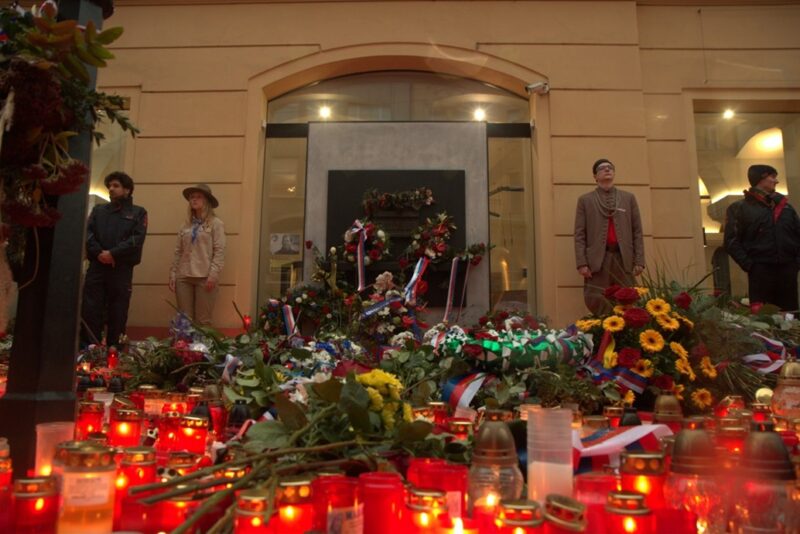
Commemoration of the Velvet Revolution on the 17th of November 2022, Národní třída, author unknow, public domain
Populism and antagonistic memories: A Binary in Need of Breaking
While memory studies and populism research have made significant strides in recent years, I argue that much of the existing scholarship on the memory-populism nexus remains locked in a binary logic—memory as a battleground of exclusion and antagonism, and populism as a politics of resentment.
My ethnographic research in the Czech Republic suggests a different pattern—one where populist politicians don’t simply attempt to erase dominant narratives and engage in mnemonic antagonism, but rather strategically reintegrate neglected memories of marginalised majority of the society. Act which undoubtedly produces emotional resonance and political legitimacy.
A Personal Story of Rupture: Anna from Opava
To understand this concept, let me introduce Anna (pseudonym), a woman I met during fieldwork in 2019 and again in 2024, in the relatively small, borderland Czech town of Opava, nearly 400 kilometres eastwards from Prague.
Anna, now in her late 50s, was a local activist and a revolutionary in 1989. She took part in the demonstrations in November 1989, co-authored a civic manifesto, and participated in the general strike that helped bring about regime change. Yet today, she avoids public commemorations of the Velvet Revolution entirely. Holding black-and-white photos of the very protests she once joined, Anna told me she’d “rather cut off her hands” than return to that square. What happened in the intervening years to create such distance?
The answer lies in how history is narrated, whose memories are commemorated, and whose are excluded.
Mnemonic Exclusion and the Limits of Liberal Memory
Much of the Czech Republic’s official memory culture is shaped by cosmopolitan liberal memory regime and the idea of ‘remembering well’. Within this framework, the remembrance of major twentieth-century events, such as the Second World War, the Holocaust, or the fall of the Berlin wall (a context to which the memory of the Velvet Revolution rightly belongs), has taken on a highly normative character. After all, as so many world leaders declared in their speeches, often invoking Santayana’s famous quote, ‘those who cannot remember the past are condemned to repeat it’. Within this regime, the official Czech commemoration of the Velvet Revolution emphasizes elite male dissidents, often confined to the capital, Prague, and often promotes didactic, morally framed narratives through institutions like state television, NGOs or national museums. While, at least from transnational justice point of view, this mode of remembrance is grounded in the idea that ‘remembering well’ is essential for democratic resilience, it also has its blind spots. Chief among them is the tendency to forget the majority of people who made 1989 possible, such as factory workers, women, and millions of activists in regions outside of Prague.
This is what I refer to as mnemonic exclusion: the symbolic marginalization of certain experiences within national as well as cosmopolitan liberal memory. These omissions are not neutral. They silence individuals and groups by excluding them from the official commemoration. Lived histories of majority of those who participated in the revolution are now absent from its retelling.
Populist Memory Politics: Not Just Erasure, but also Recuperation
Here’s where my research departs from the dominant critique of populist memory politics. Rather than dismissing populist memory politics as merely manipulative or revisionist, I argue that populist actors often engage in mnemonic inclusion, reclaiming stories of marginalised majority that have been excluded or pushed to the margins.
Take, for example, the Mayor of Opava and senator, Tomáš Navrátil, who is also a member of the ANO movement, routinely considered by political scientists as a populist party. During the commemorations of the 17th of November, the Major’s speech diverged sharply from the elite-centred narrative one could hear in the national Czech television or radio. Unlike his liberal-conservative counterpart, Zbyněk Stanjura, who emphasized the heroism of the dissidents and the moral clarity of 1989, the mayor acknowledged the ambiguities and costs of the transition. He expressed gratitude for democracy, yes, but also empathy for those who lost out. Those who faced job loss, dislocation, or simply failed to benefit from the promise of political liberalism and neoliberal capitalism. Without overtly rejecting the Revolution, he re-cantered it around those who played an essential role during it and now had been forgotten: the factory worker who lost her job, the pensioners who cannot afford their medicine, the family who struggles with housing. He appreciated the heroism and the severe losses of the non-intellectual, non-socioeconomic elite of the society. This is mnemonic inclusion in action.
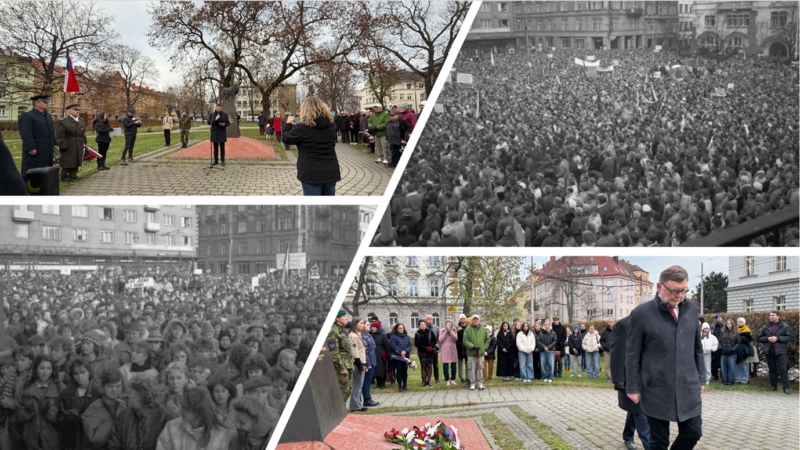
Photo collage by Johana Wyss, juxtaposing two black-and-white photographs from the General Strike demonstration in Opava in November 1989 with two images from the Velvet Revolution commemoration held in Opava in November 2024. The top-left photograph features Mayor and Senator Tomáš Navrátil (ANO), while the bottom-right picture shows Zbyněk Stanjura, Opava-born Minister of Finance and First Vice-Chairman of ODS. Photos of the commemoration taken by Johana Wyss.
Importantly, this reframing is not a denial of history, nor is it mere nostalgia. It is a repositioning of the “people” within the historical narrative, a move that offers both moral recognition and political capital. Populist actors like those in the ANO movement understand, perhaps better than liberal memory institutions, that commemoration is quintessentially about who is allowed to belong to the story of the nation. In this context, that belonging is frequently reserved for Prague based, male intellectual and political leaders and former dissidents.
To be clear, I am not making a normative case for populist commemorative politics. Rather, I am pointing to a crucial theoretical blind spot. By focusing solely on exclusion and antagonism in our research of memory-populism nexus, we miss how populism also functions as a re-integrative memory project, one that claims to restore dignity to those who feel erased. And this resonates. In a context where 75% of Czechs say the revolution ‘was worth it,’ we might assume that public memory is settled. But in the field, I found a more fragmented terrain: one of generational divides, affective ambivalence, and persistent structural inequality. People may approve of the Revolution in principle, but they reject the version of it that is offered to them. For example, Anna affirms the revolution’s value, but feels alienated from its public celebrations as well as from many of the outcomes it produced.
Ethnographic Methods and Submerged Narratives
To uncover these dynamics, I relied on ethnographic methods. By combining participant observation, interviews, and photo elicitation, I was able to surface these submerged narratives. Take, for example, the archival images of Opava’s 1989 protests above. Prior conducting my initial fieldwork focused on the commemoration of the Velvet Revolution in 2019, I had never seen these photographs. They weren’t included in textbooks or television specials. Yet, when I circulated the images online as part of my follow-up fieldwork in 2024, more than dozen people came forward to identify themselves or their family members, friends and acquittances.
Through these encounters, I gathered oral histories and personal accounts that challenged dominant commemorative scripts. I met Opavian women who had organized behind the scenes, locals who had written manifestos, and factory workers who had risked their livelihoods. These weren’t passive victims or bystanders. They were active agents in their communities’ democratic transformation.
Rethinking the Politics of Remembrance
What does all of this mean for how we understand the rise of illiberalism in Europe?
It means that we need to stop assuming that populist memory politics is only about erasure, distortion, and conflict. It’s also about resonance, recognition, and inclusion. Populist movements succeed not just by dividing society, but by reweaving memory into affective ties of belonging.
And it also means that liberal commemorative cultures, especially those that pride themselves on critical reflection and historical accuracy, must confront their own exclusionary mechanisms. If memory is to serve democracy, it must be inclusive in practice, not just in rhetoric.
Final Thoughts: Towards a More Inclusive Memory Culture
To conclude, I offer three final points:
- Mnemonic inclusion is a conceptual tool for understanding how populist actors engage memory not just by rejecting it, but by reclaiming what liberal narratives leave behind.
- This process helps explain why populism often gains traction not despite, but because of liberal commemorative practices that have become emotionally or socially narrow and highly exclusionary.
- Ultimately, the future of democracy in Europe depends not only on defending institutions and liberal democracy as such, but on reimagining the symbolic and emotional communities that memory helps to shape.
By listening more carefully to those who feel left out of the story, we can begin to reimagine a memory culture that is truly democratic—not only in its ideals, but in its inclusion.