

Humour, Memory, and Populism “From Below” in Istria: Preliminary Reflections
Author: Laura Mafizzoli
On the 27th of February 2025, La Voce del Popolo, the main journal of the Istrian Italian community in Croatia, featured a curious and provocative headline in Italian: “Đalović, il Terminator degli italiani: «Nemmeno i partigiani nel ’43»” (Đalović, the Terminator of the Italians: ‘Not even the partisans in ’43’).
The article highlighted a series of victories by Rijeka’s football team under its Montenegrin coach, Radomir Đalović. Within just ten days, Rijeka defeated its three most significant rivals: Osijek (2-0), Dinamo Zagreb (4-0), and Hajduk Split (3-1). These results were impressive not only from a sporting perspective (as all teams were at the top of the league) but also carried symbolic resonance: all three opposing teams were coached by Italians (Federico Coppitelli, Fabio Cannavaro, and Gennaro Gattuso). The article added that pundit and former player Joško Jeličić, joking about Đalović’s dominance over Italian coaches, told MaxSport (a local TV channel): Đalović “conquered the Italians in ten days… Not even the Partisans in 1943 did that! Congratulations to him and Rijeka.”
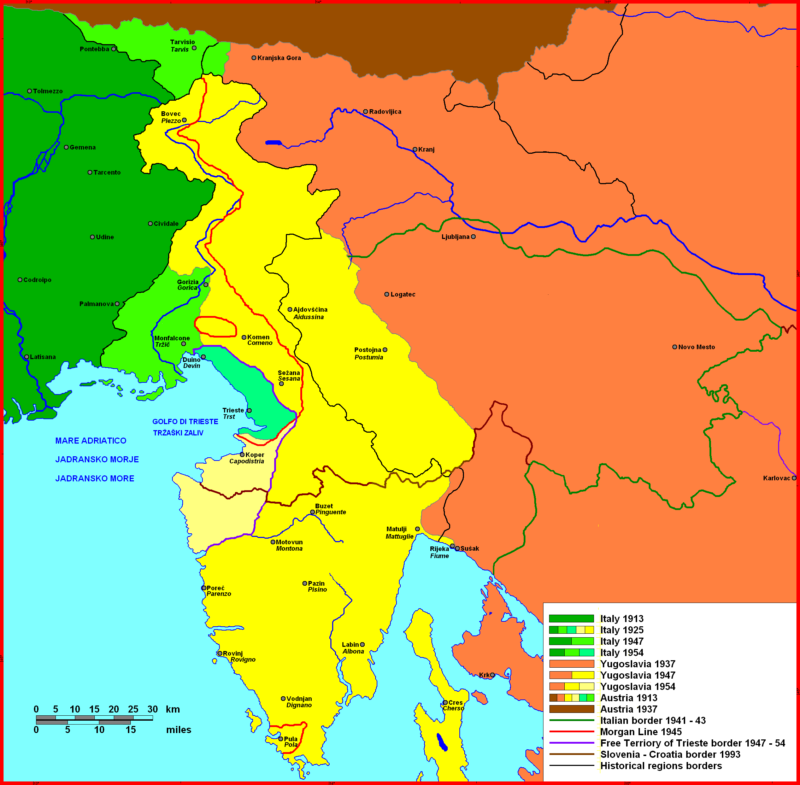
Map of Istria and changes to the Italian eastern border from 1920 to 1975. Source: Wikipedia
I watched the original video featuring Joško Jeličić, who was analysing the team’s performances with great excitement. The camera zooms in on Jeličić’s animated face as he attempts to convey the significance of Rijeka’s achievement by evoking the Yugoslav partisans’ expulsion of Italians from Istria and Dalmatia in 1943, framing it as a “conquest.” However, we can hear the interviewer laughing at Jeličić’s joke. It was a joke meant explicitly for those who understood not only the language, Croatian, but also the historical weight of the reference, and who could simultaneously either laugh or feel hurt by the reference.
The reference draws on unresolved historical tensions surrounding the presence of Partisan forces in Istria during the WWII and its aftermath. Specifically, in 1943 and again in 1945, in both Istria and Trieste, the Yugoslav army carried out killings of the so-called “enemies of the people”. In Italian national memory, these events are now referred to as the foibe massacres. During this period and in the years that followed, between 200,000 and 350,000 people, primarily from the Italian communities in Istria but also, to a lesser extent, Slovenians and Croats, migrated due to a range of factors. These included political uncertainty and fears provoked by the new political situation in Istria under Yugoslav control. This forced migration is referred to by the Italian community as the “exodus” or “expulsion”.
It is important to note, however, that these tragic events took place in the broader context of nearly twenty years of forced Italianisation in Istria under fascist rule, as well as a violent Italian military campaign in Yugoslavia between 1941 and 1943. The memory of these events thus remains highly contested and subject to political manipulation, particularly in Italy and among the Italian far right. In this context, the fascist period in Istria and the policies of Italianisation are often ignored, while the Italian exodus and the foibe massacres are frequently presented as acts of ethnic cleansing. At the same time, the Italian left and, more broadly, Croatian public discourse tend to remain largely silent on the issue. Some justify the killings and expulsions as responses to fascist violence, or portray the Italian communities in Istria as collaborators, despite the fact that many Istrian Italians also fought against fascism.
The Italian community that remained in Istria (now about 5% of the population in Croatia and 3% in Slovenia) has experienced various forms of marginalisation over the decades and is far from politically homogeneous. As the memory of WWII and the suffering of Italian minorities in Istria remains a highly sensitive topic, comments and jokes like Jeličić’s can feed into narratives of grievance and exclusion (among those who perceive themselves as “victims”), as well as narratives of pride and superiority among those who celebrate Partisan violence as a means of liberation.
The Giorno del Ricordo (Day of Remembrance), commemorated annually in Italy on February 10 since 2004, is one of the country’s most polarising memorial dates, particularly in the Italo-Slovenian borderland region. Dedicated to the victims of the post-WWII foibe massacres and the subsequent exodus of Italians from Istria and Dalmatia, the commemorative events have become deeply contested sites of collective memory. The Italian political right often frames the foibe massacres as emblematic of Italian national victimhood (neglecting the suffering experienced by the Slovenians and the Croats), whereas the left tends to contextualise the violence as a reaction to prior fascist aggression by Italy against Slovenian and Croatian populations. This ongoing tension has made the Giorno del Ricordo a focal point for competing historical narratives and political polarisation.
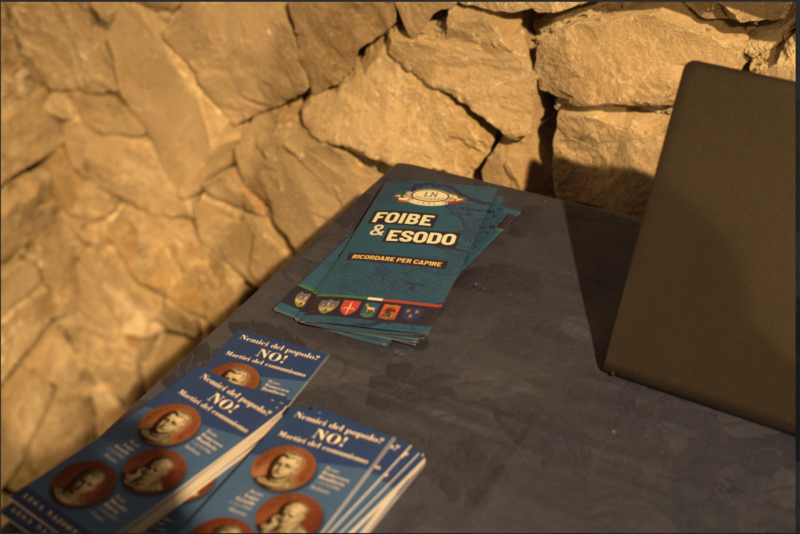
Flyers at the Foiba of Basovizza Memorial of Trieste during the Giorno del Ricordo. It is written: “Enemies of the people? NO! Martyrs of communism” and “Foibe and Exodus. Remember to understand”. Picture taken by Laura Mafizzoli.
Notably, Jeličić’s comment came precisely at a time when these commemorations had just taken place both in Italy and among the Italian minority in Istria, amplifying its potential sensitivity and symbolic weight. While his joke was likely not intended as a political provocation, it addressed a public aware of this historical reference, generating forms of exclusion and inclusion, as well as narratives of grievance and pride. The comment was followed by viral engagement on social media. Many Croatian newspaper headlines quoted Jeličić’s remark from MaxSport. On Facebook, the news was widely shared and commented on within the Croatian-speaking community, who laughed and expanded on the joke with memes and analogies, such as comparing Đalović to the Partisan hero Boško Buha.
One meme featured Furio Radin, Croatian parliamentarian and representative of the Italian minority since the 1990s, with the caption: “Talijanska manjina uložila prosvjed. Zlostavljanje talijanskih trenera u HNL-u od strane Radomira Đalovića mora odmah prestat!” (Italian minority files protest. Radomir Đalović’s abuse of Italian coaches in the Croatian National Football League must stop immediately!). This meme alone was liked and shared by more than a thousand users. It clearly leveraged the narrative of victimisation among Italian minorities, mocking the Italian minority for their presumed long history of complaints and claims of marginalisation and abuses in ethnonational tones.
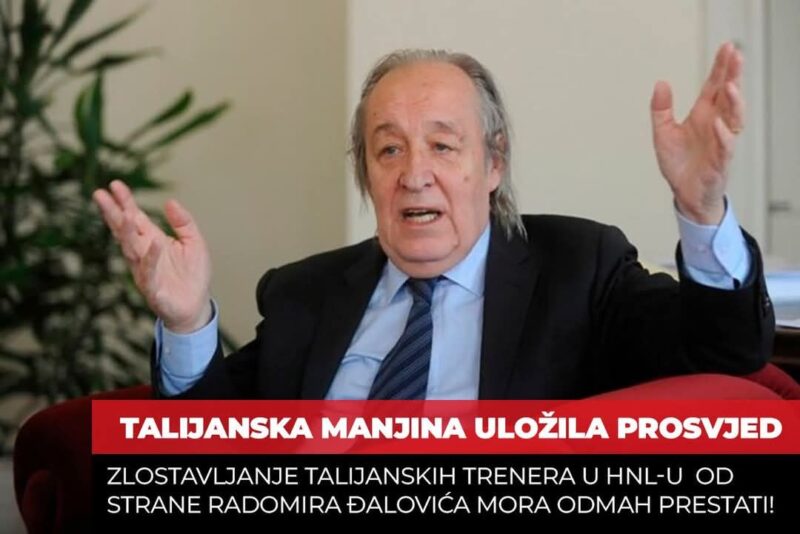
Meme featuring Furio Radin. Source: Facebook
While Croatian speakers shared it with glee, La Voce del Popolo intensified the irony by dubbing Đalović the “Terminator of Italians,” layering irony over an underlying narrative of Italian victimhood. The Facebook post itself had restricted commenting, and the article described Jeličić’s joke as “fuori luogo” (“out of place”). This characterisation highlights the exclusionary nature of jokes, which play a significant role in defining social belonging and delineating group boundaries. “Getting” the joke does not necessarily imply laughing. In this case, the joke addresses different social groups who possess knowledge of this specific past, and it uses the language of violence to position the Italian population, “conquered” by the partisans, as vulnerable. Laughing at such jokes can be seen as a reproduction of historical violence. Yet, interestingly, the title of the Istrian Italian newspaper not only called the joke fuori luogo but also played along with it by using the word “Terminator”, thus reclaiming a certain agency within a joke meant to diminish the Italian minority.
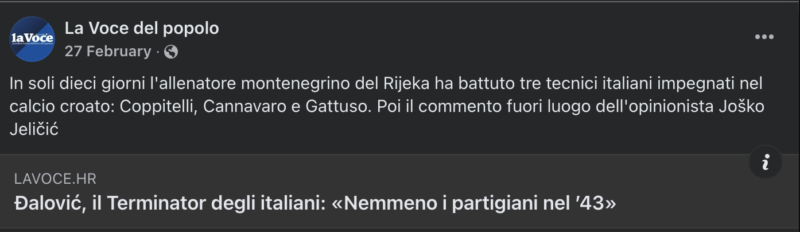
Facebook post of La Voce del Popolo “In just ten days, the Montenegrin coach of Rijeka defeated three Italian managers working in Croatian football: Coppitelli, Cannavaro, and Gattuso. Then came the comment ‘out of place’ from pundit Josko Jeličić.” Source: Facebook
This episode led me to reflect on the relationship between memory and populism, particularly through an approach “from below,” and how humour can offer useful insights into this perspective. Humour not only channels sentiments that might be described as populist, or appropriated by populists as part of their political strategies, but also functions as an epistemic practice: a way of knowing and conveying messages that are often contradictory, ambivalent, and situated at the margins, as well as across different temporalities. Precisely because laughter inherently involves both inclusion and exclusion (the joke is shared only by those who “get it,” and more viscerally, can laugh about it), humour can, to a certain extent, underpin popular sovereignty. People may laugh, or not, based on their position in relation to the joke, which in this instance references a contentious past that continues to linger in the present and which various populist parties continue to exploit.
My research is concerned not only with why people continue to vote for populist parties, but also with how the popular is performed, interpreted, and legitimised. If we consider the brief episode involving Jeličić’s comment and its circulation, we can interpret it, in Szombati’s words (2018), as a “non-institutionalised form of political agency” (a football match commentary on local TV and various social media platforms) that reproduces a populist narrative aligned with leftist justifications of Partisan violence against their enemies as acts of liberation and conquest. This narrative is exclusionary (targeting the Italian minority) and mobilises a specific, contested past. It frames those who share and laugh at the joke as righteous and superior, implicitly positioning the Italian minority as the antagonistic “other”.
When reflecting on the role of humour in populist performance, its exceptional power lies in its ability to offend, express contradictions, criticise political elites, and convey emotions and affects, all while shielding itself under the banner of “it’s just a joke” (Göpfert and N’Guessan 2025). Such jokes create a bonded community of those who “get it”, while irony prevents the comment from being taken too seriously, thereby containing its potential escalation within what might be considered democratic limits. Although Jeličić’s comment and the memes that followed do not explicitly construct a populist binary – framing it as a moral struggle between “the pure people” and a “corrupt elite” – they have the potential to target a political elite, namely, the Italian right wing engaged in revisionist interpretations of the past, while simultaneously reproducing a leftist populist narrative that keeps excluding the Italian minority in Istria from the anti-fascist campaign which many of them took part in.
As I prepare for ethnographic fieldwork, this episode has made me realise the urgency of paying close ethnographic attention not only to how populism operates in practice, but also to how humour may serve as a tool for popular sovereignty. It influences who gets the joke, who laughs, who feels included or excluded, and which historical narratives circulate as common sense. These narratives can not only be manipulated and amplified by populist actors, but can also form the basis of political struggles that embody the will of the people, struggles that simultaneously and performatively bring that very people into being (Mazzarella 2019).