

Contesting Water Authority: When Neo-Feudal Grievance Is Translated into Populist Politics in Burgenland’s Seewinkel
A late autumn evening, first snow at Austria’s borderland with Hungary, in the part of the Pannonian Plain known as Seewinkel. In one of the last local inns, around sixty people, mainly from the village and neighbouring villages, order drinks and gather in the small banquet hall. Some are already familiar to me from my ethnographic fieldwork, others through my biographical entanglement in the region. The reason for the meeting is an invitation by the Burgenland water authority. As part of an EU-funded nature restoration project, they present the planned measures for a new regional water regime. The aim is to preserve the soda pans – a unique wetland on this western edge of the Eurasian steppe belt – by raising the ground water table. But this is not only a project for nature conservation, as National Park employees, representatives of agriculture, county officials, engineers, and the municipal mayor agree: agricultural irrigation, tourism development and flood protection will profit from it. Water management, so it’s claim, is to bring “all interests under one roof.” The trope follows something like this: in the eighteenth century, we began to drain this huge wetland; today we need to “keep every drop of water in the region.”
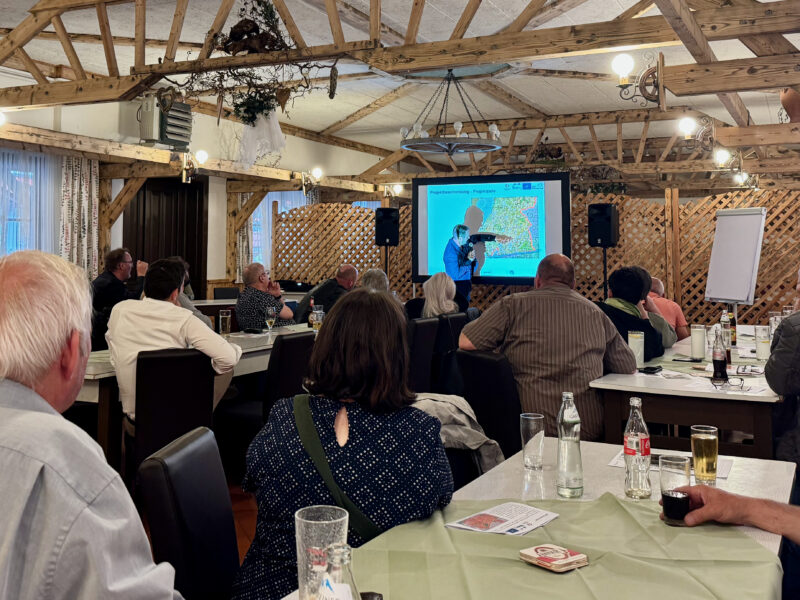
Village meeting informing local residents about the LIFE Pannonic Salt project and related technical measures for groundwater recharge. Photo by Franz Graf, May 2025.
Who Decides?
At first, the meeting still followed the script – versed presentations about the measurement of groundwater levels, repair and upgrading of canals, installation of weirs, pumps, and pressure pipes. Followed by a moderator reading out questions that had been collected in advance through the municipality, and the experts answered them one by one. Then the discussion turned to the target groundwater level, the passive atmosphere in the room began to change. Restlessness spread. Murmurs turned into interruptions, interruptions into loud interjections. People wanted to know who would control the water level in the future, who would decide on its exact setting, and who would be held accountable if something went wrong. What actual say would the local population, the municipality, and landowners have?
The exchange tipped when the head of the water authority tried to calm the room in legal-administrative language, invoking „festgelegte Beteiligungsgrundsätze laut Wasserrechtsgesetz“ and „ein Einspruchsrecht durch eine von der Behörde entschiedene Parteistellung“ – that is, a procedure in which the authority itself determines who is granted the right to object. The jargon only deepened the sense that the real question was being evaded. „You say nothing with many words,“ one local Freedom Party functionary shouted into the room. „You are not answering who will actually be in control.“ „But, I am answering that,“ the official shouted back. „It will be the operating company.“ „But who is that?“ came the immediate response from the audience. „I cannot tell you that yet. That will be determined in the water-law procedure … If you do not trust the rule of law, then there is nothing I can say to you,“ he said, now visibly on the defensive. By then, the exchange had turned openly confrontational. „You are just pushing this through over our heads,“ someone shouted. „Decisions are being made without us, but we are the ones living here.“
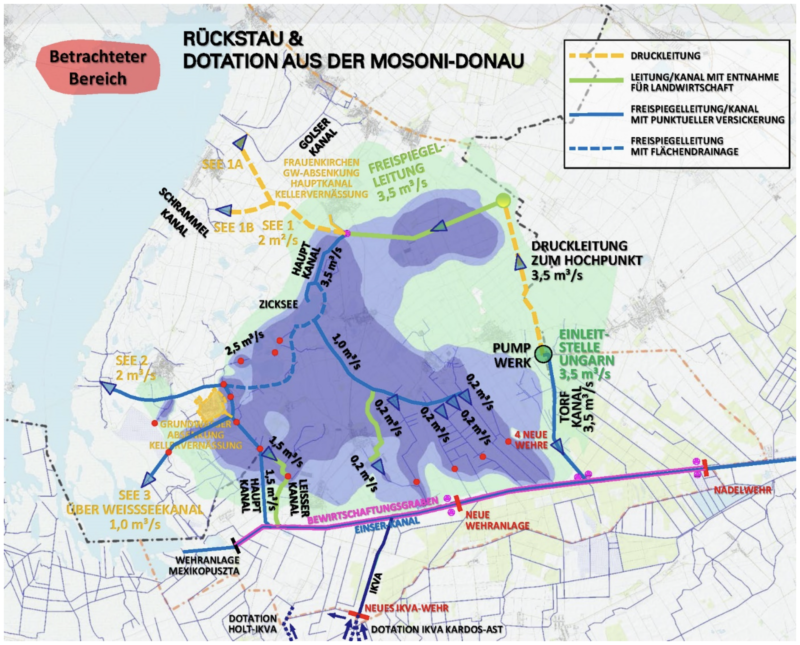
Map of the Seewinkel from a study commissioned by the Province of Burgenland on water management planning, showing possible weirs, canals and pressure pipelines for groundwater replenishment (Wögerer et al. 2021: 71).
Water Makes Power Visible
Water leaves no one indifferent because it is about more than supply or scarcity or technical manipulation. It is about people’s worth, our material condition, about pasts and futures, and about who is recognised as having a say in the transformation of landscapes. Water is deeply embedded in the political history and, from an anthropological perspective, provides a lens for thinking about inequalities, conflicts over land use, and political power (Ballestero 2019).
Only a small minority in the room openly confronted the presenters. Yet, the feelings of anger, frustration and not mattering articulated in these interruptions are much more widely shared among small and medium stakeholders I meet: having no real say, being excluded from decisions about one’s own livelihood, and being exposed to powerful actors with strong institutional backing. The sense of powerlessness – of not counting – go much deeper than could become visible in the village meeting about water management.
My ethnographic material suggests that growing pressure on water, combined with competing and unequally powerful interests amplifies socio-political tensions: many quickly come to feel unrepresented and unheard, while others manage to pursue their plans. In this paper, I use the village meeting to think about some roots of real or perceived grievances, and how these then can become available for populist translations.
In the Prince’s Shadow
I argue that a deep sense of grievance intersects with a historically and still extremely unequal distribution of landed property and the political power that comes with it. In Burgenland, I encountered one name again and again: Esterházy, the former noble family of Western Hungary. “Der Fürst” (“the Prince”), “die Herrschaft” (“the lordship”) – as people still call it – is Austria’s largest private landholding complex, owning more than a tenth of Burgenland. Esterházy appears as distinct political magnitude and has ownership and interests across all sectors affected by water management: from tourism, over agriculture, to cultural heritage and nature conservation.
Historically speaking, the role of the nobility in draining and “cultivating” the wetlands for their profits cannot be underestimated. Neither can its influence on today’s discourse around water: Esterházy hosts events where he invites county officials and experts for water management, he finances shiny publications and founds political initiatives and civil society associations to advance his concerns.
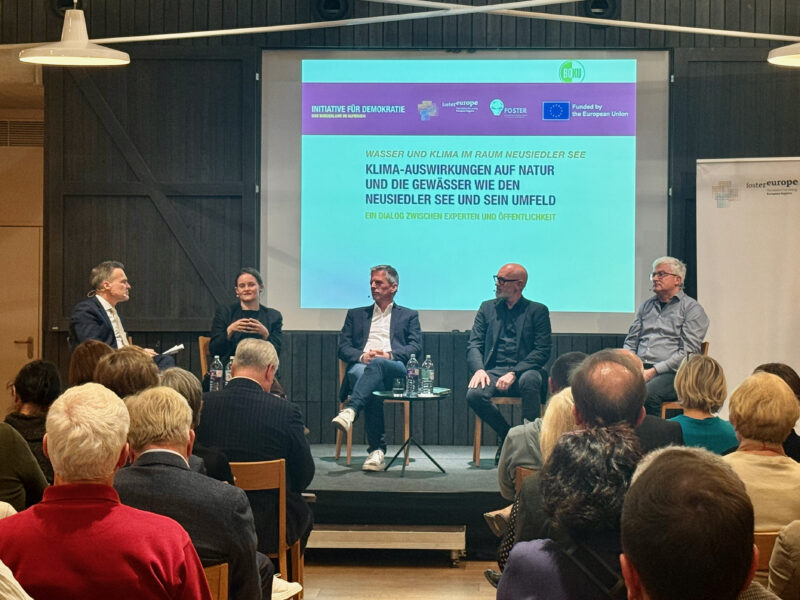
Expert roundtable on the future of Lake Neusiedl at the winery of Esterházy Betriebe AG, organized by the company’s own “Initiative for Democracy” in the former Meierhof (manorial farmstead). Photo by Franz Graf, November 2025.
As small and medium farmers often complained, they experience themselves as those held responsible for water scarcity and environmental destruction. They have to justify themselves, deal with an overburdening bureaucratic apparatus, and live with a high degree of uncertainty, while large landed complexes appear to enjoy a different access to politics, better lawyers, better land, better European funding, and ultimately better possibilities to shape the discourse and the rules in their favour. One peasant summarized: “The Esterházys will take care of themselves. It will be us who bear the consequences.” For some, there is little doubt that, should Esterházy decide it wants a pipeline to fill up “its” Lake Neusiedl, no scientific assessment would be able to stop it.
I use the term neo-feudal here not to claim a simple survival of premodern rule, nor merely the symbolic persistence of aristocratic dispositions within democratic society. Following Benczes et al. (2020), I understand neo-feudalism as a contemporary pattern in which dependencies and unequal access to institutions provide economic security and options to for some, while others remain exposed to uncertainty.
No political force in Burgenland, so it seems, can really afford to confront Esterházy. As one former Social Democratic Party member put it to me, „instead of fighting an endless battle that we can never win, the Social Democrats decided to accommodate themselves to the former nobility.“
My point is not whether these rumours and allegations are true, but to argue, that they form part of the affective reality of mistrust and resistance to the water authority’s claim that they would bring “all interests under one roof.” It is far from transparent, whose interests they are referring too. Even less are these heterogenous interests treated as the underlying basis for a political struggle between actors of unequal power. Who profits, who gets heard, who does not, and at which levels decisions are actually taken? These questions remain largely in the dark. The promise to reconcile „all interests“ obscures that not all interests enter the process with the same weight. Water becomes a problem of technical optimisation, hydraulic intervention, regulation; while questions of power fade from view.
Into Populist Politics
This Depoliticisation of the issue of water – combined with long standing grievance about not counting – comes with a cost. The frustration of that evening was taken up weeks later in the Austrian national parliament. An MP from the Freedom Party spoke of a „democratic scandal“ in Burgenland and tapped into the real existing feelings of marginalisation and not-mattering. He amplified fears of flooded basements, and of losing agricultural land and municipal development opportunities. He did not invent the affective concerns. What he did was translate these grievances into a simple party-political antagonism: here, „the local population“ and „the little man“; there, the unprofessional and arrogant Social Democratic system of Burgenland’s governor, trampling over the concerns of its own people.
Still, the Freedom Party does touch on a real democratic weakness: the unresolved question of who is actually heard and who gets to have a say in far-reaching decisions about the future of the region. Missing from its framing, however, are the heterogeneous interests among local actors – similarly to the Water management authority – especially the role of large landowners, and the wider political economy of who has the power to shape such projects, who bears their costs, and who profits.
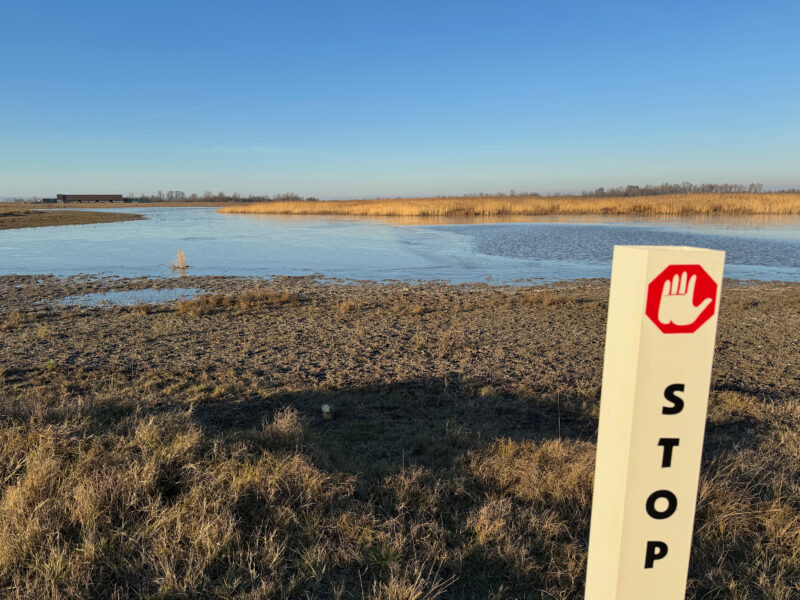
One of the remaining soda pans, highly dependent on groundwater and human intervention. Photo by Franz Graf, December 2024.
A Different Translation
One moment in the village meeting was, in this respect, both disruptive and revealing. Johann, himself an organic farmer and chair of a small landowners’ interest group, raised his voice. In the middle of the heated exchange, he interrupted the hardening division of „us“ versus „them“ between the water authority and the allegedly populist crowd. Trying to translate as much as to mediate, he addressed the head of the water authority and clarified: „people do not want to know the names of those who would sit on the decision-making body; what they want to know is according to which rules the body would be appointed.“ In doing so, he referred to a part of the water law-procedure and the only democratic element within an otherwise technical and depoliticised process.
Speaking „as someone burned by past experiences with nature conservation projects and the like,“ he argued for discussion at eye level, local participation, and the involvement of interest groups. He expressed that only through associations of small and medium landowners can questions of contractual nature conservation, compensation for agricultural losses, and cooperative water management be effectively negotiated. For a short moment, a translation of grievance became visible that directed to organizing interests, democratic participation and accountability of the state.
What Depoliticization Leaves Untouched
To sum up. It is not simply populism in its demand or supply side, that we see here. Technocratic depoliticization in water management fails to address grievances rooted in deeper inequalities of land, access, and worth. In Burgenland, governance unfolds in a field marked by post-imperial and neo-feudal relations of property and influence. The affective charge can then be subjected to a second, populist depoliticization: that seizes on experiences of devaluation, but translates them selectively into a simplified „people“ versus „system“ matrix that leaves structural inequalities largely untouched.
What remains politically ambivalent and analytically interesting, as Johann’s intervention suggests, is the transformation of the feeling of not counting into concrete actions of collective power against entrenched forms of neu-feudal authority.
—
Bibliography
Ballestero, Andrea (2019) The Anthropology of Water. Annual Review of Anthropology 48, 2019): 405-421.
Benczes, István, István Kollai, Zdzisław Mach and Gábor Vigvári (2020) Conceptualisation of Neo-Traditionalism and Neo-Feudalism. In POPREBEL Working Paper 2, Eds.. J. Kubik und R. Mole.
Wögerer, Christine, Gabriel Bodi and Alfred Paul Blaschke (2021) Machbarkeitsstudie zur Erstellung eines Wasserbewirtschaftungsplans für das Projektgebiet Grenzraum Österreich (A) – Ungarn (H): Interner Bericht mit Seezuleitung. Eisenstadt: Amt der Burgenländischen Landesregierung.